

Staying Charged Up in Dolores with Solar Power
Let’s talk about power, more specifically solar power, and how we keep all our devices and tools charged up while working and traveling in our 2003 Toyota Tundra, Dolores.
We designed our overland solar setup in Dolores with simplicity and efficiency in mind. We started by examining three main areas: what do we need to charge, how much energy storage do we need, and how much do we want to spend?
Electrical Demands - Since the build out in Dolores is currently quite simple we knew that this could be a much smaller, simpler solar system than the one we built in Peanut, but we still need to charge our laptops, drone, many camera batteries, and wifi tools that we rely on for work, including our starlink satellite internet.
Energy Storage - In general we spend the majority of our time recreating around Colorado and the desert southwest where there is an abundance of sunshine! Storing energy isn’t much of an issue there when we have amazing solar production. However, we knew that we’d also be traveling to less sunny areas (like Alaska) so our battery system needed to be efficient and large enough to last a few days potentially without solar input.
Cost - Based on the simplicity of the build out in Dolores, we knew that we wanted to keep the cost of this system as low as possible and get the most bang for our buck.
We’ve had several different iterations of our solar system on Dolores over the years—starting small and incrementally making changes as we are able. The solar setup that we initially installed in Dolores—Version 1.0—taught us a lot of lessons. We upgraded our solar system to Version 2.0 which treated us well for a long time. We added more solar and are currently on Version 2.5.
Check out the details of how we designed and built each version plus the tools and gear we used through the links below!

Solar System Version 1.0
(May 2022 - October 2022)
We started small with a very simple plug and play system.
100W solar
50Ah battery capacity

Solar Setup Version 2.0
(October 2022 - November 2025)
We learned a lot from our first solar set up and quickly decided to upgrade! Here is why and how we upgraded our solar system.
300W solar
150Ah battery capacity
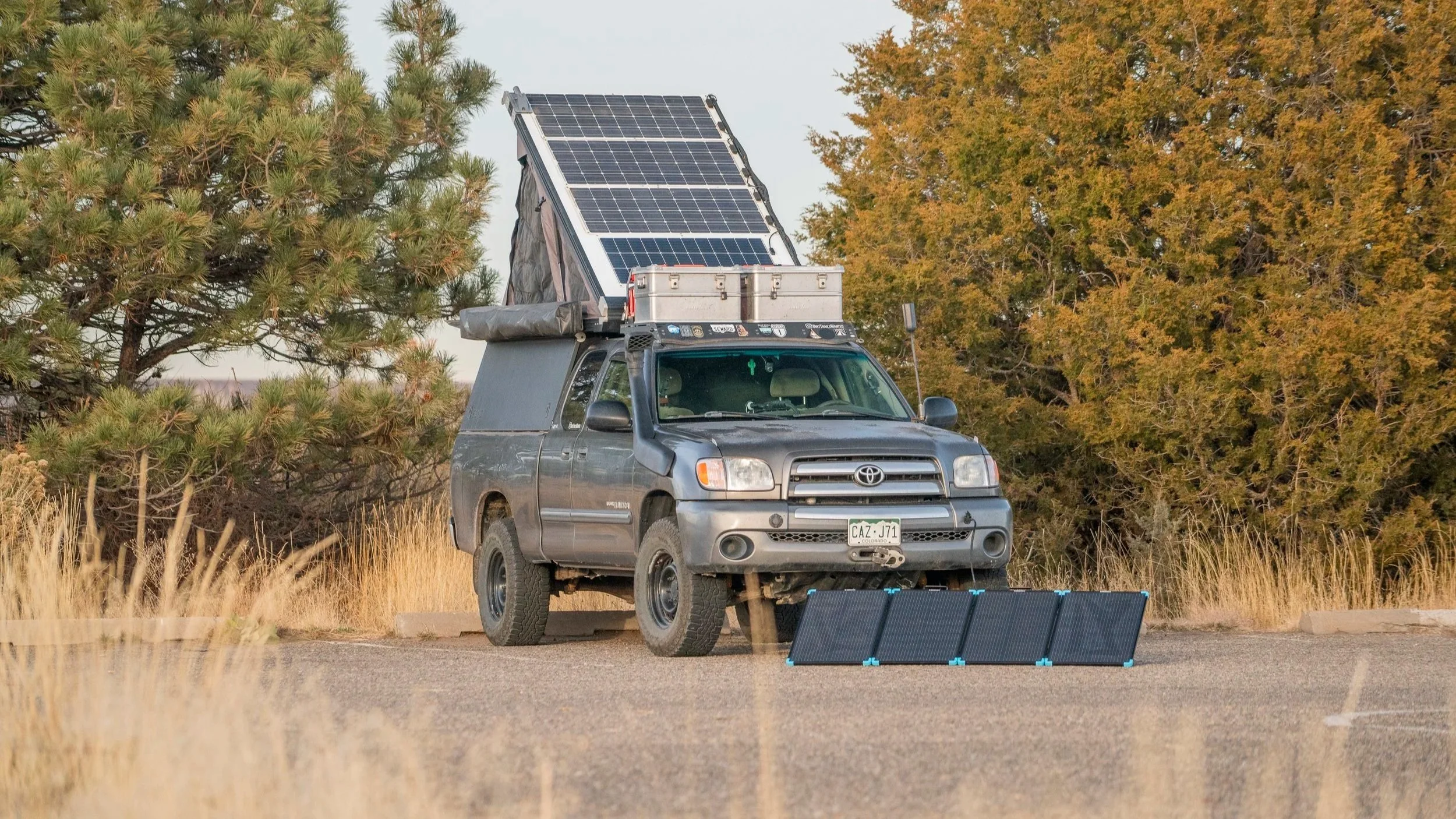
Solar Setup Version 2.5
(November 2025 - Present)
We got the opportunity to partner with Renogy to add more solar to our rig.
620W solar
150Ah battery capacity
